
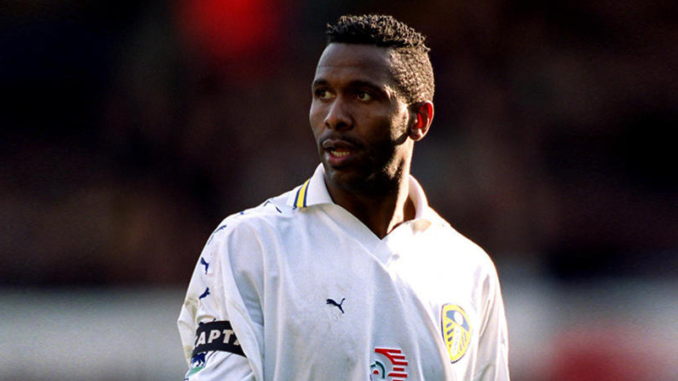
Lucas Radebe is one of the most beloved figures in South African football — not only for what he achieved on the pitch, but for the grace, dignity, and leadership with which he achieved it. A central defender and captain of both Leeds United and the South African national team during the late 1990s and early 2000s, Radebe built a reputation that transcends football statistics. He was the kind of player that turns supporters into devotees, and the kind of captain who elevates those around him simply through the quality of his commitment.
Lucas Radebe Biography
| Full Name | Lucas Valeriu Radebe |
| Date of Birth | April 12, 1969 |
| Age | 57 years old (as of 2026) |
| Nationality | South African |
| Ethnicity | South African Black (Zulu) |
| Birthplace | Diepkloof, Soweto, Johannesburg, South Africa |
| Profession | Former Professional Footballer (Defender), Ambassador |
| Known For | Leeds United captain, Bafana Bafana captain, 1996 AFCON winner, Nelson Mandela tribute |
| Nickname | The Chief |
Early Life and Background
Lucas Radebe was born on April 12, 1969, in Diepkloof, Soweto — the same vast township that produced so many of South Africa’s most prominent public figures. Growing up in Soweto during the 1970s and 1980s was to grow up in the epicentre of South Africa’s anti-apartheid struggle, and the political consciousness of that environment inevitably shaped Radebe’s understanding of what it meant to carry his country’s colours.
He is of Zulu heritage, one of South Africa’s largest and most culturally prominent ethnic communities. Football was the dominant outlet for his competitive energy growing up, and he progressed through local and national youth football systems before attracting the attention of Kaizer Chiefs — one of South Africa’s two most supported clubs.
Career Journey
Radebe’s professional career began at Kaizer Chiefs in the early 1990s, where he established himself as a commanding, technically capable defender. His performances attracted international attention, and in 1994 he made a move that would define the rest of his career: he signed for Leeds United in the English First Division (later the Premier League) in a deal that also brought goalkeeper Philemon Masinga to the club.
At Leeds, Radebe’s career was initially disrupted by a serious shooting incident in Johannesburg during an off-season return home — a frightening episode that required significant recovery but ultimately did not diminish his ability or ambition. He returned to full fitness and established himself as one of Leeds’ most important players during the late 1990s.
Under manager David O’Leary, Leeds United assembled a talented young squad that finished third in the Premier League in 2000 and reached the semi-finals of the UEFA Champions League in the 2000–01 season. Radebe was the captain of that team — a South African leading one of England’s biggest clubs in the latter stages of Europe’s premier club competition. It was a remarkable achievement. His partnership with Rio Ferdinand in central defence was considered one of the best in English football at that time.
One of the defining images of Radebe’s career came not on a football pitch but at a political event: when Nelson Mandela attended a match at Elland Road, he singled out Radebe for a personal greeting on the pitch — a moment that captured Radebe’s symbolic importance to South Africa and the global Black community.
Internationally, Radebe captained Bafana Bafana and was part of the squad that won the 1996 Africa Cup of Nations on home soil — one of South Africa’s most celebrated sporting achievements and one of the first major moments of national sports pride in the post-apartheid democratic era.
Personal Life
Radebe experienced significant personal tragedy when his wife, Feziwe Radebe, passed away in 2004 following an illness. He has spoken publicly about this loss and its impact on him. He later remarried. He is a Christian and has been involved in various humanitarian causes, using his profile to advocate for social issues including HIV/AIDS awareness — particularly significant in the South African context.
Net Worth
Radebe’s exact net worth is not publicly confirmed. A career at Leeds United throughout the Premier League era, combined with his national team service and post-retirement work as an ambassador and public figure, point to a comfortable financial position. Specific figures are not available in verifiable public sources.
Legacy
Lucas Radebe’s legacy is written in two different languages: the language of South African sporting history, where he is a national hero, and the language of English football culture, where Leeds United supporters still speak his name with profound affection. “The Chief” is not merely a nickname — it is an accurate description of how those who watched him play experienced his presence. He was a leader, in every sense.
Frequently Asked Questions
Why is Lucas Radebe called “The Chief”?
The nickname reflects his commanding leadership on the pitch and the deep respect he earned from fans, teammates, and opponents at Leeds United and in South African football.
Did Lucas Radebe win the Africa Cup of Nations?
Yes, he was part of the Bafana Bafana squad that won the 1996 AFCON, hosted on South African soil, in one of the country’s first great democratic-era sporting moments.
What is Lucas Radebe’s connection to Nelson Mandela?
When Mandela visited Elland Road for a Leeds United match, he personally greeted Radebe on the pitch — a moment that captured Radebe’s significance as a symbol of post-apartheid South Africa’s possibilities.
Where did Lucas Radebe grow up?
He grew up in Diepkloof, Soweto, in Johannesburg, and is of Zulu heritage.
What year did Lucas Radebe join Leeds United?
He signed for Leeds United in 1994, going on to become one of the club’s most revered captains.
Leave a Reply